Ecological balance
Silent SpringEcological balance is the changing web of relationships between living things and their surroundings, built over immense spans of time and expressed in the limits, dependencies, and adjustments that shape communities. In Silent Spring, it is both a natural process and a standard by which human interventions are judged: landscapes are not empty spaces awaiting improvement, and a measure that suppresses one pest can unsettle the relations on which other life depends.
A Long History of Adjustment
The book begins its account of ecological balance with the history of life on Earth. Living things have interacted with their surroundings throughout that history; the environment has shaped the forms and habits of plants and animals, while each species has developed within conditions that can support or threaten it. The resulting relationships are neither a static arrangement nor a simple harmony. They are the outcome of life developing, evolving, and diversifying through hundreds of millions of years, reaching states of adjustment with surroundings that include both hostile and sustaining elements.
This timescale matters to Carson’s argument. Environmental conditions can exert rigorous pressure on life, and the communities they shape cannot be treated as collections of interchangeable parts. Balance describes the relations and constraints that have emerged over time—not an assurance that nature is gentle or unchanging. Human attempts to remake those relations rapidly therefore risk consequences that the narrow measure of a single target species cannot register.
Simplification and the Release of Pests
Carson traces many insect problems not to agriculture in the abstract but to its intensification. Under more primitive agricultural conditions, farmers faced few insect problems; those problems grew as immense acreages were devoted to a single crop. Monoculture creates unusually favorable conditions for particular insects, allowing their populations to increase explosively. A wheat-feeding insect, for example, can build up where wheat supplies extensive suitable habitat.
The contrast is between the variety of the natural landscape and the simplifying impulse of human agriculture. Diverse landscapes contain built-in checks, including limits on the amount of appropriate habitat available to any one species. Replacing that diversity with a uniform crop weakens those constraints. The resulting pest outbreak is not simply an invasion from outside a stable system; it is also a consequence of how the landscape has been arranged.
This account recasts chemical control as a response to conditions that agricultural simplification helped create. A method of massive chemical control has achieved only limited success, Carson argues, while threatening to worsen the conditions it is meant to curb. The more the system is simplified and then treated as a problem requiring eradication, the more readily a narrow intervention can miss the ecological causes and dependencies that shape the outbreak.
Chemical Intervention and Unintended Change
The same risk appears below ground, where insecticides can alter relationships among organisms rather than merely remove a target pest. Carson describes the disruption of beneficial relations between fungi and the roots of higher plants, as well as damage to the root nodules necessary on leguminous plants. These effects matter because ecological balance includes connections that may be less visible than the insects an application is intended to kill.
In soil communities, reducing some organisms can upset the balance between predators and prey and lead to explosive increases in others. The change is not a tidy subtraction from an ecosystem: suppressing one population can loosen a constraint on another. Such shifts make the consequences of treatment difficult to contain within the original target, and can undermine functions on which plants and other organisms depend.
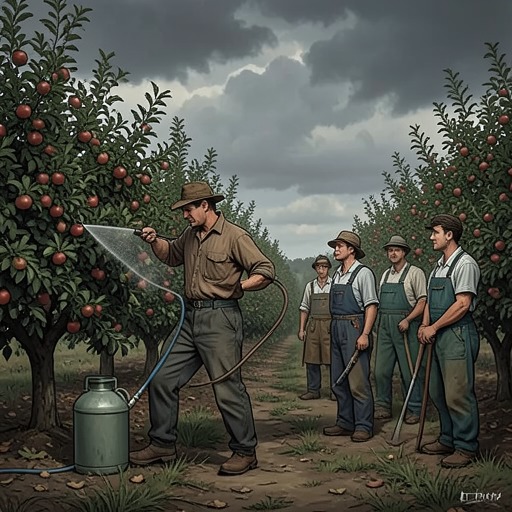
Carson’s examples distinguish directed intention from actual ecological reach. A spray may be applied to alter one part of a landscape, yet affect non-target plants and the animals dependent on them. Ecological balance makes those indirect effects central evidence, not incidental damage: the consequences must be followed through the relationships that connect species, habitat, and human use of the land.
The Sage Country and Its Dependencies
The high western plains and lower mountain slopes offer a landscape in which long adjustment can be read in place. Shaped by the uplift of the Rocky Mountain system millions of years ago, the sage country is marked by harsh climatic extremes, including long winters. Carson presents its plant and animal life as fitted to those demanding conditions. The pronghorn antelope and sage grouse are among the animals associated with this land; the sagebrush community is not simply an obstacle to grass production but part of the system to which its inhabitants have adapted.
That relation is threatened when land-management agencies pursue more grazing land at the demand of cattlemen, treating improvement as the conversion of sage country into grassland without sage. The conflict is not merely over the appearance of a landscape. It concerns which forms of life and land use the management decision recognizes, and which relationships its simplified ideal removes. Carson’s shift from describing the land in terms of balance to questioning whether it remains balanced marks a change already underway.
Spray, Habitat Loss, and the Meaning of Improvement
A shotgun approach to vegetation control can eliminate plants that were not the intended targets. Carson cites an account by William O. Douglas of spraying in Bridger National Forest, where about 10,000 acres of sage lands were treated after pressure from cattlemen for more grazing land. The consequences extended beyond sagebrush. Willows were killed by the same indiscriminate spray, affecting the beavers that depended on them and changing a region known for recreation, fishing, and hunting.
When Douglas visited in 1959, the year of the spraying, he saw the willows shriveled and dying. The visible damage gives a specific form to the larger ecological argument: a landscape cannot be converted in one dimension without consequences in others. A decision framed as improvement for grazing reaches plants outside its intended target and the animals and human activities connected to them.
The book’s wider examples reinforce that ecological balance is a practical way to understand consequences, not a claim that every natural arrangement is fixed or invulnerable. In the fall of 1959, for instance, 27,000 acres in southeastern Michigan, including suburbs of Detroit, were heavily dusted from the air with aldrin pellets. Against the background of the growing use of persistent poisons and the accumulating destruction of wildlife, such programs illustrate the scale at which intervention could operate. The core question remains whether control measures account for the relationships through which effects travel, or merely count the target they set out to suppress.
Ecological balance therefore binds together the book’s account of agricultural practice, chemical treatment, and altered habitat. Carson’s professional concern with the widespread use of DDT and other long-lasting poisons in agricultural control programs leads her away from the research projects she had intended to pursue and toward the argument of Silent Spring. Across its cases, the decisive contrast is between the slow, complex formation of ecological relations and the confidence that a large-scale intervention can simplify nature without setting off changes elsewhere in the web.